MicroeSIM Review and Comparison with Top eSIM Providers in 2026
11/2/2026
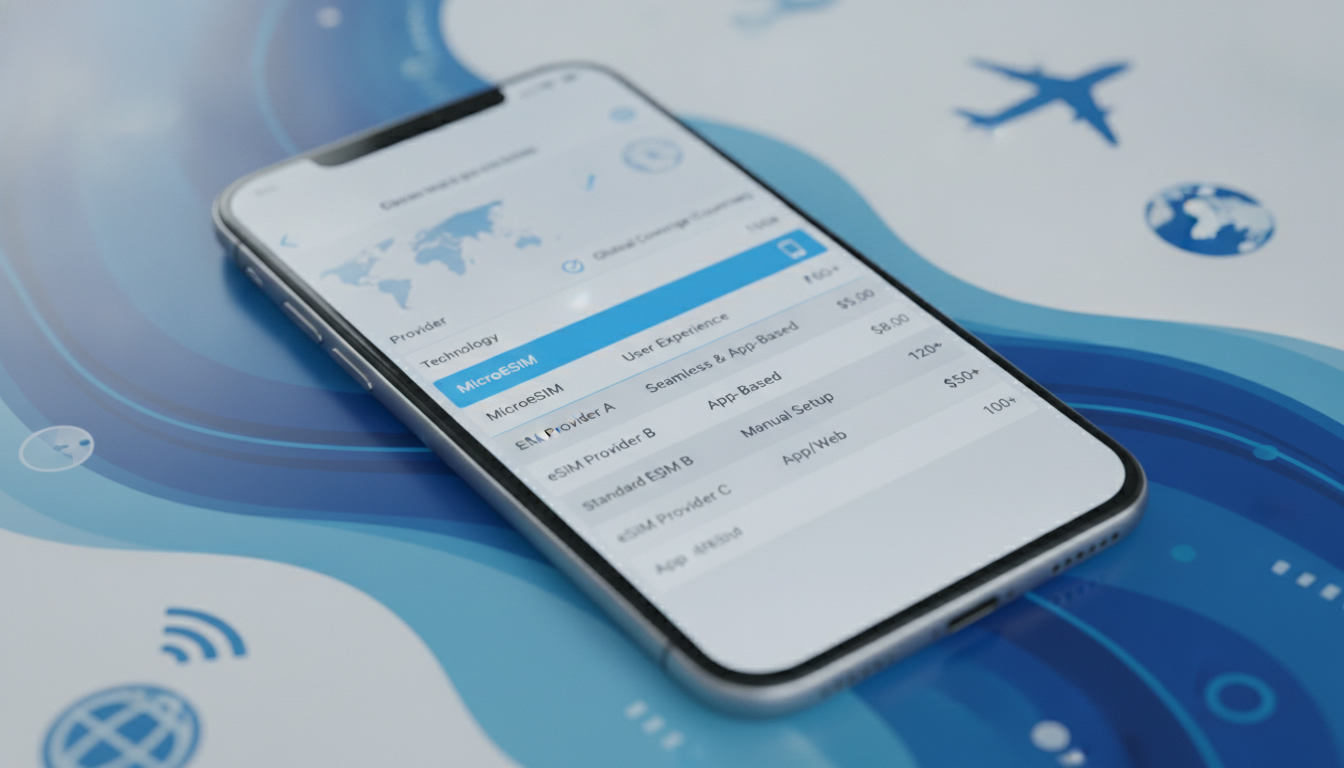
MicroeSIM Review: How It Stacks Up Against Other eSIM Providers for Travel Data
Switching from a physical SIM card to an eSIM can simplify your travel connectivity, but is MicroeSIM the right choice? With coverage in over 200 countries and instant activation from your phone, MicroeSIM promises convenience without the hassle of swapping cards or calling carriers.
However, when compared to other top eSIM providers, there are important factors to consider: pricing, compatibility, user experience, and network performance. Here’s a detailed review that puts MicroeSIM head-to-head with its competitors so you can decide if it’s worth making the switch.
Comparing MicroeSIM With Other Leading eSIM Providers
When evaluating MicroeSIM alongside providers like Holafly, Airalo, and Simbye, the first thing travelers look at is pricing and coverage. MicroeSIM offers data plans starting as low as $0.86 for 1 GB valid for 3 days in countries like Malaysia, Thailand, and Singapore.
This is competitively priced but not always the cheapest option available.
Pricing and Promo Codes Overview
| Provider | MyBestSim Rank | User Rating | Promo Code | Discount on Unlimited Plans |
|---|---|---|---|---|
| Holafly | 3 | N/A | MYBESTSIM | 5% |
| Simbye | 5 | 4.3/5 | MYBESTSIM | 20% |
| Airalo | 6 | 4.6/5 | MYBEST15 | 15% |
| LinkeSIM | 12 | 4.5/5 | MYBESTSIM | 5% |
| Nadanada | 13 | 4.2/5 | MYBESTSIM | 10% |
| Yatelo | 14 | 4.2/5 | MYBESTSIM | 15% |
| MicroeSIM | 67 | 3.8/5 | MYBESTSIM | 10% |
MicroeSIM ranks lower on MyBestSim compared to these providers and has a slightly lower user rating of 3.8 out of 5, indicating mixed user experiences. The promo code “MYBESTSIM” gives a 10% discount on unlimited plans, which can make it more affordable for heavy data users.
Coverage and Network Quality
MicroeSIM boasts coverage in over 200 countries, which is on par with other major providers like Airalo and Holafly. However, the quality of local connections depends heavily on partnerships with local carriers.
For example, MicroeSIM uses local networks in Southeast Asia to provide fast connections but may not have the same depth of coverage or speed in less popular destinations.
A key field observation is that if you activate a micro eSIM in a country where the provider lacks strong carrier partnerships, your data speeds can drop significantly, leading to frustrating browsing or streaming experiences. This happens because roaming agreements vary by region and provider.
User Experience: Setup, Activation, and Compatibility
One of the biggest selling points of MicroeSIM is its instant activation process—no need to visit a store or wait for a physical SIM card delivery. You simply scan a QR code or download the profile directly onto your phone.
How to Activate a MicroeSIM
- Purchase your plan on MicroeSIM’s website.
- Receive an activation QR code via email.
- Scan the QR code with your phone’s camera or through settings.
- The eSIM profile downloads instantly; enable it in your cellular settings.
- Start using data immediately without swapping SIM cards.
The mechanism here relies on the GSMA specification SGP.22, which governs remote eSIM provisioning standards ensuring secure profile downloads and activation without physical cards.
However, I always start by checking device compatibility before buying any eSIM plan because not all phones support micro eSIM profiles equally well. For instance:
- Apple iPhones from XS onward support multiple eSIM profiles but limit simultaneous active lines.
- Google Pixel models from Pixel 3 support eSIM but may have regional restrictions.
- Some Android phones require carrier unlocks or software updates for smooth micro eSIM use.
If your device isn’t fully compatible, you risk activation failures or limited functionality such as no voice calls or SMS over eSIM data plans.
Common Setup Pitfalls
A frequent mistake users make is trying to activate multiple micro eSIM profiles simultaneously without proper management in settings, which can cause conflicts and loss of connectivity. The concrete consequence is that your phone may default back to cellular roaming charges on your physical SIM if the micro eSIM fails silently.
Advantages and Disadvantages of Using MicroeSIM Compared to Traditional SIM Cards
Switching from traditional SIM cards to micro eSIMs offers clear benefits but also some trade-offs.
Advantages
- No physical card swapping: You avoid fumbling with tiny SIM trays at airports or during layovers.
- Instant activation: Plans activate immediately upon purchase—no waiting days for shipping.
- Multiple profiles: You can store several eSIM profiles on one device and switch between them without removing cards.
- Better security: Embedded SIMs reduce risks of physical damage or loss.
Disadvantages
- Device dependency: Not all phones support micro eSIMs fully; older models are incompatible.
- Carrier restrictions: Some carriers don’t allow porting numbers or voice services over eSIMs yet.
- Potential hidden costs: If you don’t disable your physical SIM properly, you might incur roaming charges unknowingly.
- Limited offline management: Unlike physical SIMs you can swap anytime without internet access, managing multiple micro eSIMs requires online access for activation/deactivation.
A key field insight is that when switching to an eSIM during travel, failing to disable the physical SIM’s data roaming leads to unexpected charges because phones often prioritize physical SIM networks by default unless manually switched.
How MicroeSIM Fits Into the Future of Mobile Networks
The latest microeSIM technology aligns with industry trends toward embedded connectivity governed by GSMA standards like SGP.22 for remote provisioning and SGP.24 for subscription management. This means:
- Carriers can push updates or new profiles remotely without user intervention.
- Travelers gain flexibility with instant global data plans activated anywhere.
- IoT devices increasingly rely on micro eSIMs for seamless worldwide connectivity.
MicroeSIM’s approach reflects this future by offering instant access to travel data packs across Asia-Pacific regions with plans starting around $0.86 per GB valid for three days—a competitive entry point for short trips.
However, I’d advise against relying solely on MicroeSIM if you plan extended travel across less-covered regions because their network partnerships aren’t as extensive as some top-tier providers like Holafly or Airalo.
For those curious about how switching works technically, understanding ICCID (Integrated Circuit Card Identifier) codes helps track each profile uniquely—a topic I cover in detail at how ICCID works.
Balancing Cost Versus Convenience: Is MicroeSIM Worth It?
MicroeSIM’s pricing is attractive for short-term travelers needing quick data access in Southeast Asia with plans around $0.86 per GB for three days’ validity in Malaysia, Thailand, and Singapore. But when factoring in user ratings and network reliability compared to higher-ranked providers offering broader coverage and better customer support, it’s a mixed bag.
If you prioritize:
- Instant setup without visiting stores,
- Moderate travel within well-covered countries,
- A budget-friendly option with occasional promo codes (like “MYBESTSIM”),
then MicroeSIM could be a solid choice.
But if you want:
- Extensive global coverage beyond Asia-Pacific,
- Stronger customer service reputation,
- More flexible long-term plans,
providers like Holafly (ranked #3) or Airalo (#6) might serve you better despite slightly higher prices.
For travelers who want detailed insights into activating their micro eSIM safely while avoiding common pitfalls like accidental roaming charges or profile conflicts, I recommend reading my guide on how to activate a microeSIM.
This review highlights how MicroeSIM compares realistically with other providers based on verified pricing from MyBestSim rankings, user ratings, activation processes governed by GSMA standards, and practical field observations about device compatibility and roaming behavior—key factors that only someone deeply familiar with travel tech would emphasize when choosing an eSIM provider today.
FAQ
How does MicroeSIM pricing compare to other providers?
MicroeSIM offers competitive pricing starting at $0.86 per GB for short-term plans in Southeast Asia. While affordable, it is not always the cheapest option compared to providers like Simbye or Airalo, which may offer better discounts or longer validity periods.
What devices are compatible with MicroeSIM?
MicroeSIM supports most modern smartphones, including Apple iPhones XS and newer, and Google Pixel 3 and later. However, some Android phones may require carrier unlocks or software updates, and older models might not support micro eSIM profiles fully.
How easy is it to activate a MicroeSIM plan?
Activation is instant and straightforward: purchase a plan online, receive a QR code by email, scan it with your phone, and enable the eSIM profile in settings. This process requires no physical SIM swapping and follows GSMA remote provisioning standards.
What are common issues travelers face with MicroeSIM?
Users often encounter activation conflicts when managing multiple eSIM profiles simultaneously, which can cause connectivity loss. Also, if the physical SIM’s data roaming isn’t disabled, unexpected roaming charges may occur due to default network prioritization.
Is MicroeSIM suitable for long-term international travel?
MicroeSIM is ideal for short trips within well-covered regions like Southeast Asia but may lack extensive network partnerships for less popular destinations. For longer or global travel, providers with broader coverage like Holafly or Airalo might be better choices.

Emma Rossi
Emma is a travel and consumer-tech writer who hunts down the best deals for getting online abroad. At eSIM Vouchers she tracks verified coupons from the major providers and explains how to redeem them for the lowest price on travel data.